Match The Craft
Start with the experience you want, then choose the platform that supports it.
A practical editorial guide to kayaking and paddle boarding, built for people who want to understand the craft, prepare with intention, move efficiently, and feel more confident on the water.
CHOOSE THE RIGHT PLATFORM. READ THE WATER. BUILD A CLEAN STROKE. KEEP THE SESSION CONTROLLED.
Paddle sports can be quiet, athletic, exploratory, technical, or all four at once. A kayak places you low and connected to the water with a double-bladed paddle and a stable seated position. A paddle board opens the experience vertically, giving you a wider view, a more active balance challenge, and a highly adaptable platform for calm-water exploration.
This guide focuses on the decisions that shape a better session: how to choose between a kayak and paddle board, what to check before launch, how to use efficient body mechanics, how conditions change the experience, what supporting gear matters, and when the smartest move is to stay close to shore or save the session for another day.
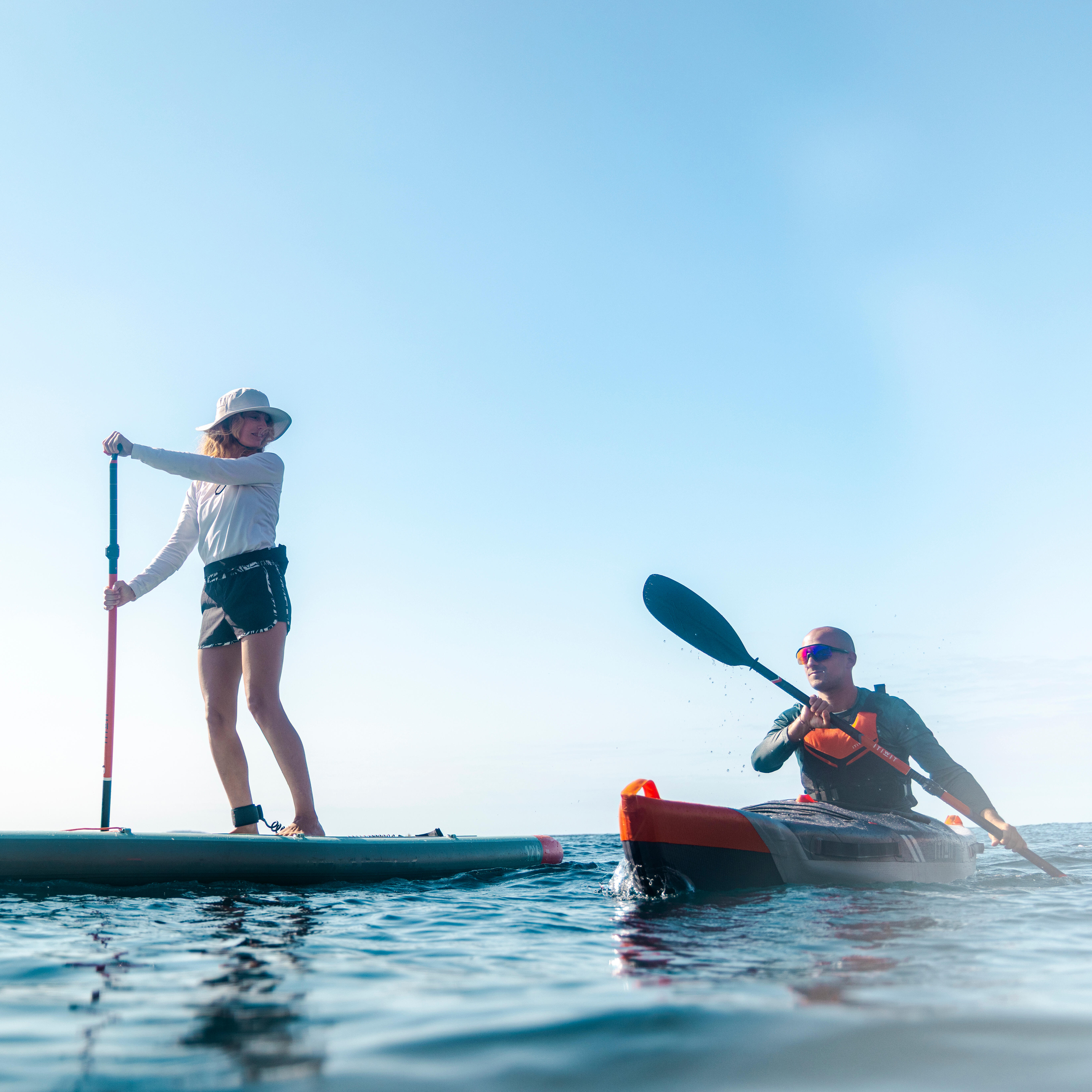
Start with the experience you want, then choose the platform that supports it.
Wind, current, temperature, traffic, and shoreline access all shape the session.
Good technique uses posture, rotation, timing, and relaxed control instead of brute force.
Keep enough energy, time, and distance margin to return comfortably.
There is no universal winner. The better choice is the one that matches how you want to move, what kind of water you expect, how much gear you carry, and how much stability or freedom you value.
A seated paddling platform that places your center of gravity low and close to the water. Kayaks are often an intuitive choice when stability, distance, carrying capacity, or a more enclosed paddling position matters to the experience.
A wide, open platform that can be paddled from kneeling or standing positions. Paddle boards offer an elevated view, easy movement around the deck, and a highly direct connection between balance, stance, paddle placement, and board response.
Better paddling begins before the first stroke. Fit, posture, equipment layout, launch position, and route awareness all influence how comfortable and controlled the session feels once you move away from shore.
Choose equipment that makes sense for your body size, intended use, skill level, and expected conditions. The goal is not simply to fit onto the craft; it is to create a stable, controllable relationship between paddler, paddle, and platform.
Keep essential items secure and position frequently used equipment where it can be reached without forcing a major balance shift. Loose items can become distractions as soon as wind, waves, or boat traffic increase.
Select a launch point with enough space to enter the water without rushing. Begin in a controlled depth and keep the craft oriented so you can settle into position before dealing with more exposed water.
Think tall rather than rigid. Keep your shoulders relaxed, your core active, and your grip light enough that the paddle can move naturally. Efficient posture reduces unnecessary fatigue.
A route is not complete until the return leg has been considered. Reserve energy for the trip back, especially when wind or current may make the return more demanding than the outward leg.
Distance from shore, daylight, temperature, fatigue, and changing weather should all remain comfortably within your capability. A good session does not require using every available margin.
Efficient paddling feels deliberate rather than aggressive. The paddle enters cleanly, the body creates controlled power, the craft responds, and the blade exits before the stroke turns into drag.
A death grip on the paddle can create tension through the forearms, shoulders, and neck. Hold the paddle securely without squeezing harder than necessary. The goal is control with fluid movement.
Think stable hands, relaxed shoulders.Place the blade forward with intention rather than beginning the stroke beside the hip. A clean forward placement gives you more useful stroke length and reduces the temptation to pull too far behind the body.
Reach without collapsing posture.Let controlled torso rotation support the stroke. Relying only on the arms can fatigue smaller muscle groups quickly. Rotation helps create a more connected movement from body to paddle.
Power through structure, not tension.Finish the useful part of the stroke before the blade travels too far behind you. A late exit can create extra resistance and pull the body out of an efficient position.
Finish the stroke, then reset.Pay attention to how the craft responds after several strokes. Correct small directional changes early instead of allowing the board or kayak to drift far off course before making a large correction.
Small corrections preserve momentum.Sustainable rhythm matters more than a few powerful strokes. Choose a cadence you can maintain while still being able to observe the environment, adjust direction, and preserve energy.
Smooth is efficient. Efficient lasts.
The same route can feel completely different as wind, current, temperature, visibility, and boat traffic change. Reading the environment is part of paddling technique, not something separate from it.
Notice which direction the wind is moving before committing to distance. A comfortable outward leg can become a demanding return if the wind is working against you.
Current, tide, river flow, boat wake, and reflected waves can affect speed and stability. Understand the environment before leaving protected water.
Air temperature alone does not describe exposure risk. Dress and plan for the water temperature and the possibility that you may unexpectedly enter the water.
Know where you can safely return to land. Rocky edges, private property, steep banks, surf, or dense vegetation can make an apparent shoreline a poor exit point.
The best time to solve a problem is while both feet are still on land. Use a short pre-launch routine to reduce avoidable distractions once the session begins.
Inspect the kayak or paddle board for visible damage, loose components, pressure issues on inflatables, and anything that could affect normal control. Confirm seats, fins, valves, deck attachments, and carry points are in expected condition.
Confirm the paddle is assembled correctly and suitable for the activity. Inspect joints, blades, adjustment mechanisms, and grip areas before taking the craft away from shore.
Use an appropriate personal flotation device and confirm that it fits correctly and is in serviceable condition. Follow applicable local rules and manufacturer guidance for your activity and location.
Review current and expected wind, weather, water conditions, temperature, visibility, and local advisories. Conditions at launch are only part of the planning picture.
Know the planned direction, realistic turnaround point, alternate exit options, and approximate time on the water. Avoid turning a casual outing into an unplanned endurance test.
Fatigue, dehydration, cold, heat, illness, or discomfort can affect balance and decision-making. Adjust the session to the way you actually feel, not the plan you made earlier.
A craft that feels calm and predictable on sheltered water can demand a completely different skill set when wind, current, surf, or traffic increase. Match the session to your experience.
Protected lakes, coves, and other low-energy environments can provide useful space for learning balance, basic strokes, turning, stopping, and remounting skills without immediately adding complex water movement.
Larger bodies of water can build wind-driven waves and create long distances from shore. Pay close attention to wind direction, exposure, changing weather, and how much energy remains for the return.
Even gentle current changes how quickly the craft moves relative to shore. Know downstream hazards, legal access points, bridges, obstructions, and the practical plan for returning or arranging transportation.
Tides, current, swell, wind, shoreline exposure, and marine traffic can create a more complex environment. Experience, local knowledge, and conservative planning matter.
Breaking waves, fast current, strainers, rocks, and other dynamic hazards can turn paddle sports into a technical discipline. Use suitable equipment and seek qualified instruction before entering environments beyond your existing training.
The craft is only one part of the system. Clothing, flotation, footwear, eye protection, sun protection, storage, and hydration can shape comfort and control just as much as the board or kayak itself.
Choose a craft with suitable dimensions, capacity, stability, construction, and intended-use characteristics for the environment you plan to paddle.
Use an appropriate, properly fitting personal flotation device. Confirm that it is suitable for the activity, comfortable enough to wear correctly, and consistent with applicable requirements.
Select the correct paddle type for the craft. Kayaks typically use a double-bladed paddle, while stand-up paddle boards normally use a single-bladed paddle.
Water-friendly footwear can improve grip and protection around launch points, rocky shorelines, docks, and shallow areas where underwater surfaces may be difficult to see.
Sunglasses can reduce glare and improve comfort during bright conditions. Use a secure fit so normal movement, spray, and wind are less likely to separate them from you.
Water reflects sunlight and can increase total exposure. A suitable sun-protection layer, combined with other appropriate protection, can make longer sessions more comfortable.
Secure items that should stay dry and prevent loose equipment from shifting around the craft. Keep essential items accessible without cluttering the paddling area.
Carry hydration and any route-appropriate essentials needed for the planned duration, environmental conditions, and level of exposure.
A good route is more than a line across water. It accounts for access, exposure, distance, conditions, time, ability, and the simplest safe way to end the session.
Match the environment to the least experienced paddler in the group. A location that is exciting for one person may be stressful or inappropriate for another.
Start with a route that leaves meaningful energy in reserve. Distance should reflect conditions, temperature, experience, and the difficulty of the return.
Decide in advance where the route should turn back. A clear turnaround point helps prevent the outward leg from expanding simply because conditions feel easy.
Build extra time for slower progress, rest, changing weather, launch congestion, and unexpected delays. Avoid planning a return that depends on everything going perfectly.
A kayak rewards rhythm, relaxed posture, clean blade placement, and small steering corrections. Avoid treating every stroke like a maximum-effort pull.
Sit tall enough to rotate comfortably without becoming rigid.
Maintain useful contact points with the seat and foot support appropriate to the kayak design.
Keep the paddle movement balanced from side to side rather than overworking one arm.
Learn controlled stopping and turning before increasing distance from shore.
Practice recovery and re-entry skills appropriate to your kayak in a controlled environment.
A paddle board responds directly to stance, weight transfer, wind, and paddle placement. Staying relaxed often improves balance more than trying to hold the body rigid.
Begin kneeling if standing immediately feels unstable or rushed.
Keep the feet positioned around the board's stable center area rather than too close together.
Keep the knees soft so small board movements can be absorbed naturally.
Look outward rather than staring continuously at your feet.
Practice getting back onto the board in controlled water before depending on that skill farther from shore.
Use a properly fitting personal flotation device appropriate to the activity and comply with applicable local requirements. Equipment only helps when it is suitable, serviceable, and used correctly.
Cold-water exposure can affect breathing, movement, and decision-making quickly. Dress for realistic water exposure rather than relying only on warm air temperature.
Leash choices depend on the environment and can carry different risks in moving water, surf, current, or around entanglement hazards. Use equipment appropriate to the specific environment and seek qualified guidance when uncertain.
For exposed or longer outings, make sure someone knows where you plan to paddle, who is going, and when you expect to return.
Conditions can change after launch. Continue observing the sky, wind, temperature, visibility, and water surface instead of treating the pre-launch check as the final decision.
Stay alert around powered vessels, channels, docks, crossings, and areas with limited visibility. Do not assume other water users have seen you.
Learn how to manage an unexpected swim and how to return to your craft in an environment where practice can be done safely. Technique is easier to use when it has been practiced before it is needed.
If conditions, energy, equipment, or confidence begin moving in the wrong direction, an early turnaround is often the strongest decision. Distance is never more important than margin.
This guide provides general recreational information and is not a substitute for qualified instruction, local regulations, manufacturer instructions, or location-specific safety guidance. Paddle sports involve inherent risks. Choose conditions and equipment appropriate to your training and experience.
From planning the session to receiving your equipment, TideTrail keeps the store experience straightforward with clear customer-service standards for our U.S. storefront.
Customer support is available around the clock when an order or service question needs attention.
All products sold by TideTrail are covered by our store-wide free-shipping standard.
Our standard order delivery expectation is 3–5 business days.
Join our email list and save 18% under the current TideTrail subscriber offer.
TideTrail provides free returns and exchanges within 30 days.
Every question remains closed by default. Open only the topic you need for a cleaner, faster reference.
Many beginners find the lower seated position of a stable recreational kayak immediately comfortable, while a paddle board adds a more active balance component.
That does not make one universally easier. Craft width, design, conditions, body size, confidence, and prior experience all influence the learning curve.
Yes. Beginning from a kneeling position can help you learn board movement, paddle placement, and directional control before adding the extra balance challenge of standing.
Use calm, appropriate conditions and transition gradually when you feel comfortable.
Kayak paddles normally have a blade at both ends because the paddler alternates strokes from side to side while seated.
Stand-up paddle board paddles normally use a single blade and are switched between sides as needed for propulsion and steering.
Sheltered, calm water with easy shore access is generally a better learning environment than exposed, windy, fast-moving, or surf conditions.
Choose a location appropriate to your actual ability and check local requirements before launching.
A standing paddler and exposed board present meaningful surface area to the wind. Wind can change speed, direction, balance, and the effort required to return.
Conditions that feel manageable near launch can become more demanding as distance from shore increases.
Route planning should consider how wind direction will affect both legs of the trip. The important principle is to avoid using most of your energy on an easy outward leg only to discover that the return is substantially harder.
Keep the route conservative and reassess conditions continuously.
Clothing should reflect water temperature, air temperature, sun exposure, wind, expected duration, and the realistic possibility of entering the water.
Water shoes, suitable sun-protection clothing, and appropriate flotation can all be important parts of a recreational paddling setup.
Use an appropriate, properly fitting personal flotation device and comply with the rules that apply to your location, craft, and activity.
Local regulations can vary, so verify current requirements before entering the water.
Leash use is environment-specific. The same setup may not be appropriate for flatwater, surf, rivers, current, or areas with entanglement hazards.
Understand the risks of the environment you are entering and use equipment consistent with qualified guidance for that setting.
There is no universal distance. Begin with a route that stays comfortably within your energy, skills, conditions, and access to shore.
A shorter session that ends with energy in reserve is a better foundation than an ambitious route that requires struggling to return.
Relax unnecessary tension, use efficient posture, engage the torso, keep the paddle movement clean, and avoid turning every stroke into a maximum-effort pull.
Sustainable rhythm usually matters more than short bursts of power during recreational touring.
Practice basic propulsion, stopping, turning, maintaining direction, managing balance, and recovery skills appropriate to your craft.
Build those skills in controlled conditions before depending on them in a more exposed environment.
Turn back before the situation becomes urgent. Increasing wind, changing weather, fatigue, cold, equipment concerns, reduced visibility, discomfort, or loss of confidence are all valid reasons to shorten a route.
Yes. TideTrail provides 24/7 customer support for store-related questions. Our current store standards also include free shipping on all products, a 3–5 business day delivery expectation, and free returns and exchanges within 30 days.
Need help with a TideTrail order, delivery question, return, exchange, or store-related product inquiry? Our customer support service is available 24/7.
Contact TideTrail